

Bee Attacks in Safford & Thatcher: What to Do | Hydra Pest Control
Written by the Hydra Pest Control team, Arizona-licensed (license #9790)
Last reviewed:
If bees attack, cover your face with your shirt or hands, run to the nearest car or building and close the door. Don't swat and don't jump into water. Call 911 for many stings, trouble breathing or a known allergy. Then leave the colony alone and call a licensed pest control company, like Hydra's Gila Valley branch, to remove it.
Recent update, October 19, 2026: The Eastern Arizona Courier reported two bee attacks in Graham County in eight days. On Oct 10 in Solomon, four people were stung, including a 12-year-old boy, and one woman later reported trouble breathing. On Oct 2, a person was stung several times outside Denny's in Thatcher (Courier, Oct 14, 2026). On Oct 15, bees swarmed out of a burning utility pole on Concho Street (Courier blotter, Oct 16, 2026). If bees chase you, cover your face, run to a car or building and get inside (University of Arizona Extension).
What to do if bees attack you
Run, cover your face and get inside
- Cover your head and face with your shirt, your hands or whatever you have. Bees go for the eyes, nose and mouth (USDA ARS).
- Run to the nearest car or building, go inside and close the doors. A few bees may follow you in; that is far better than staying outside (UA Extension; USDA ARS).
- No shelter nearby? Keep running or walking fast for at least 240 yards, about two football fields, or until the bees stop following you (UA Extension).
- If you can't move, crouch down, cover your face and stay as still and calm as you can (UA Extension).
What not to do
- Don't swat or flail. The University of Arizona calls it the worst thing to do, and crushed bees give off a scent that draws more bees (UA Extension; USDA ARS).
- Don't jump into a pool, canal or river. The bees will wait for you far longer than you can hold your breath (UA Extension).
- Don't go back in to rescue someone. Tell them to run for shelter and call 911 (USDA ARS). Small children may need help getting away.
Getting stingers out
Once you're safe, get the stingers out fast. A honey bee's stinger keeps pumping venom for several minutes. Scrape it out with a fingernail or the edge of a card instead of pinching it, which can squeeze in more venom (UA Extension). The Arizona Poison and Drug Information Center says to remove stingers within seconds by any means and to call 1-800-222-1222 if symptoms are unusual or get worse quickly.
When to call 911 after bee stings
- A serious stinging attack: call 911 to report it (USDA ARS).
- Signs of an allergic reaction, like trouble breathing, chest tightness or swelling away from the sting. This is an emergency (Poison Control). One sting can cause a deadly reaction in a sensitive person (Arizona Poison and Drug Information Center).
- Multiple stings on a child, an older adult or someone with heart or breathing problems (Mayo Clinic).
If you're not sure, call 911 or Poison Control at 1-800-222-1222. Most healthy adults can withstand several hundred stings, and the University of Arizona notes that panic causes more deaths than the stings themselves (UA Extension). Stay calm, get inside and get help.
Bee attacks in the Gila Valley this October
The Eastern Arizona Courier reported these incidents in Graham County (Courier, Oct 14, 2026; Courier blotter, Oct 16, 2026):
- Solomon, Oct 10: a deputy found three women and a 12-year-old boy who had been stung near Main Street and Bowie Avenue. The boy had about eight visible stings, including on his face, and one woman later had trouble breathing. Paramedics treated them, and Safford firefighters cleared bees from their vehicle and found the hive.
- Thatcher, Oct 2: one person was stung several times outside Denny's. Thatcher Fire Department responded.
- Central area, Oct 9: a caller on North Webster Road reported bees swarming and acting aggressively.
- Concho Street, Oct 15: an old utility pole caught fire, and bees nesting inside it swarmed as it burned.
Why bees can be more defensive this fall
Swarming starts in spring and continues through the year while flowers supply pollen and nectar (UA Extension). A Willcox beekeeper told the Courier that recent rain brought more wildflowers, so colonies have built up, and that he has seen more highly aggressive colonies this year. In the Gila Valley, bee calls don't stop when spring ends.
Found a swarm or colony at your home? Leave it alone
Swarm or colony?
A swarm is a cluster of bees hanging on a branch, fence, eave or box while scouts look for a new home. Swarms are usually not defensive and often move on within 24 to 72 hours. A colony has moved in: you'll see steady traffic in and out of one hole, and the bees get more protective once they're raising young (UA Extension).
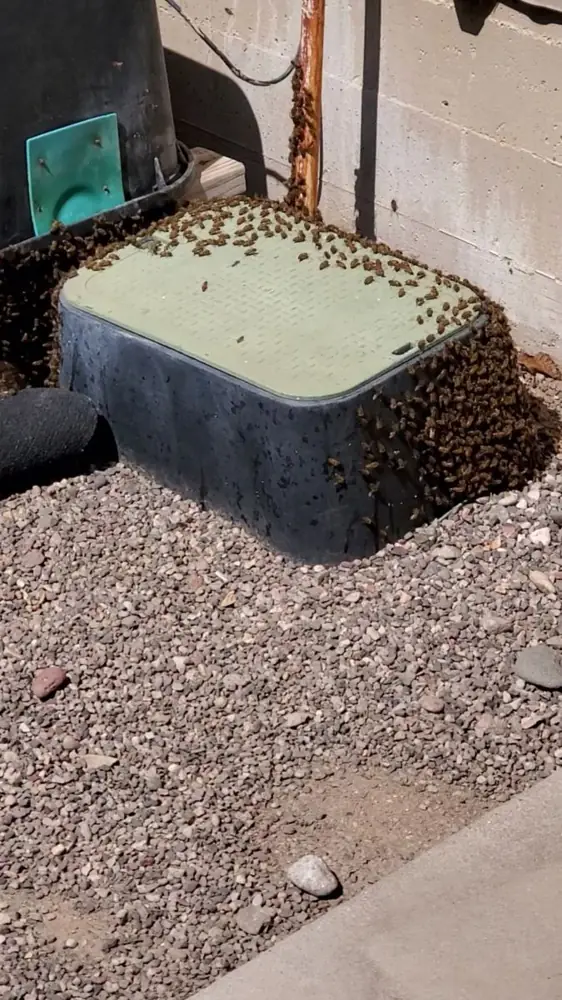
A swarm settling on an irrigation box. Boxes like this are a common place for bees to move in.
Don't spray, hose, burn or seal it
The University of Arizona is clear: don't try to remove a colony yourself, and never shoot at it, throw water, rocks or gasoline on it, or burn it. It doesn't recommend pesticide sprays on swarms or colonies, and it says not to seal a hole while bees are still using it (UA Extension). The burning pole on Concho Street shows how fast a disturbed colony turns dangerous. Keep kids and pets away and call a pro.
Where Gila Valley colonies hide
Wild bees move into enclosed spaces: hollow block walls, wall voids, attics and crawl spaces, in-ground irrigation and water meter boxes, sheds, hollow trees and old poles (UA Extension). Signs to watch for:
- Steady bee traffic in and out of a crack, vent, eave or box
- A loud hum from inside a wall, floor or box
- Bees bumping into you near one spot on your property
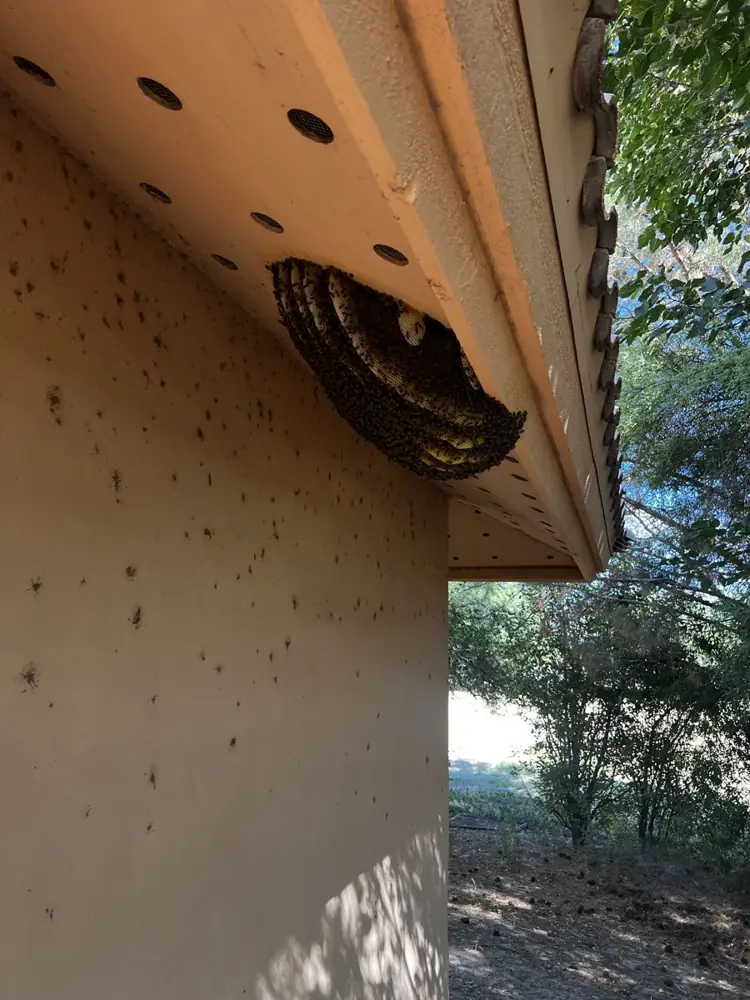
A colony building comb under an eave.
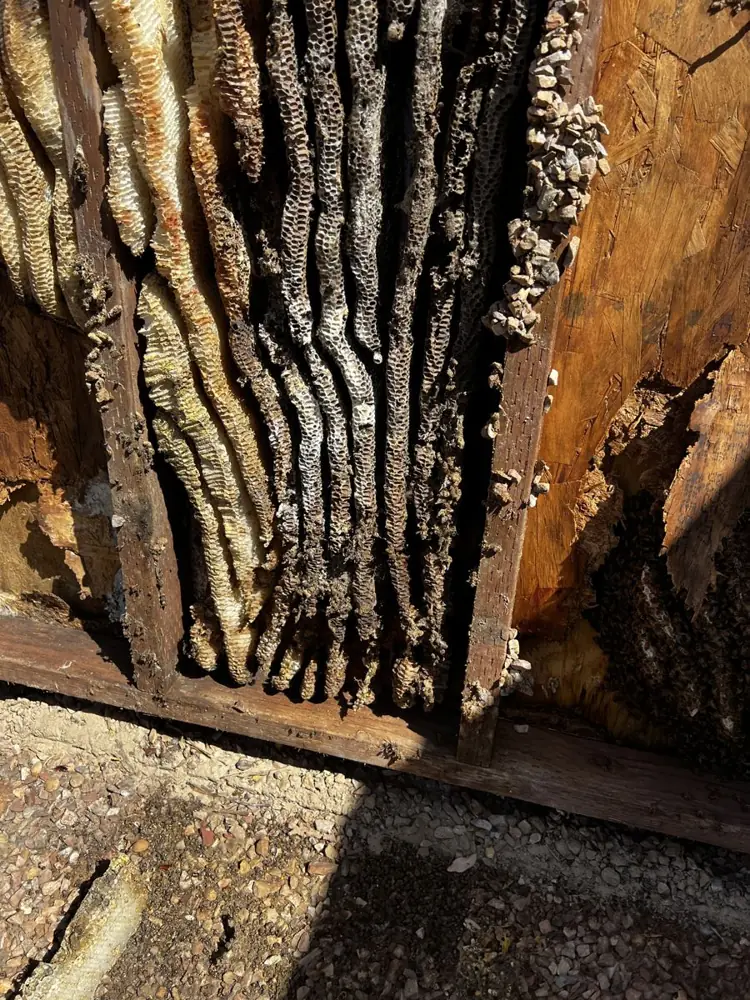
Comb inside a wall cavity. Once a colony moves into a wall, the comb has to come out, or new swarms will move back in.
Who removes bees in Safford, Thatcher, Pima and Solomon
Hydra Pest Control's Gila Valley branch, based in Thatcher, removes bee swarms and colonies across the Gila Valley, including Safford, Thatcher, Pima and Solomon. Here's how it works:
- Same-day service is typically available whenever possible. Call or text as soon as you see a swarm or steady bee traffic.
- Your Service Pro looks at where the bees are and confirms the plan in your free custom quote.
- Want the bees kept alive? We can relocate them through a beekeeper we work with.
- When safety comes first, or the colony is in a hard-to-reach or complicated spot like a wall, floor or roof void, we exterminate the colony using protective gear.
- We remove the comb whenever access allows, so honey doesn't leak and new swarms aren't drawn to the old nest, and we recommend how to close up the entry point.
- Our bee removal is backed by a 1 year warranty.
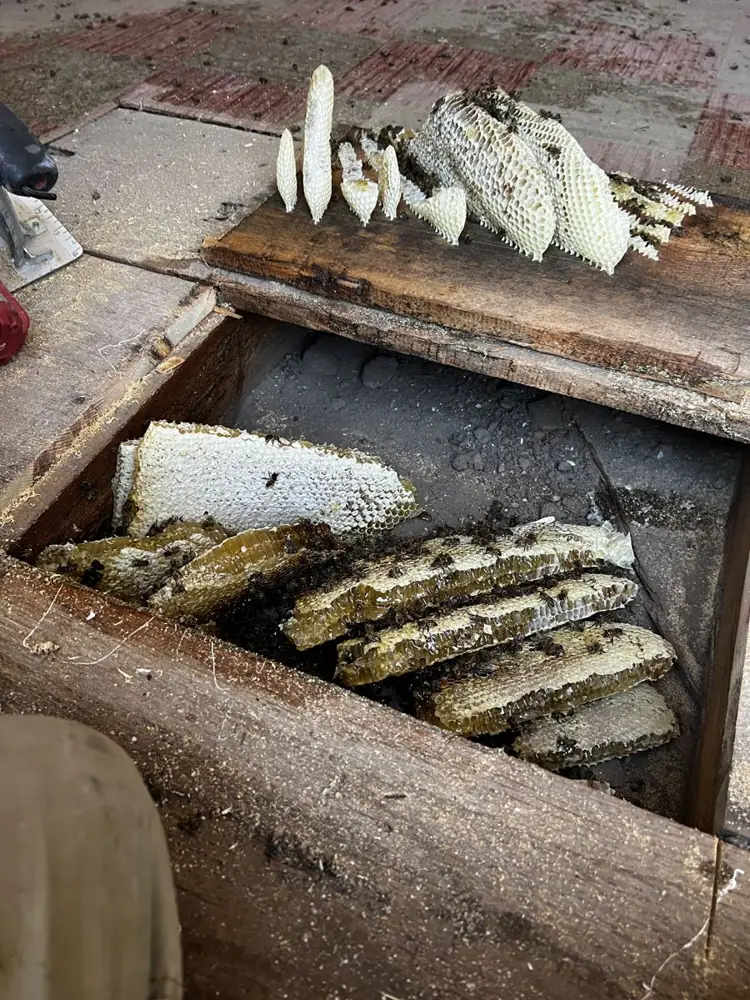
Comb removed from under a floor hatch, so the space doesn't attract the next swarm.
See how our bee removal service works, learn to identify bees, or read our full Arizona Africanized bee guide.
Bees at your business
We take commercial bee calls too: restaurants, offices, schools, churches, shops and other places where customers or staff walk past a colony. If bees are near an entrance, a drive-thru or a parking area, keep people away from the spot and call or text the Gila Valley branch at (928) 432-6200.
Keep bees from moving in
The University of Arizona recommends (UA Extension):
- Fill holes 1/8 inch or larger in walls and structures, but never while bees are using them
- Put mesh screening over water meter boxes, rainspouts and chimneys
- Fix leaky outdoor taps and irrigation lines
- Remove things bees can nest in, like overturned clay pots
- After a colony is removed, clean out the space and seal it so new swarms don't move back in
Late summer brings wasps too. See our wasp control page.
Proof & trust
- AZ Office of Pest Management License
- #9790