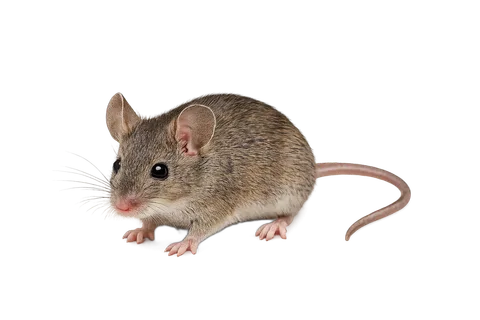
Small rodents that squeeze through openings about 1/4 inch wide.
House mice are the most common rodent inside Arizona homes. They breed quickly, contaminate food, and gnaw on wiring, creating both health risks and fire hazards.
Mice are nocturnal and curious, they explore new objects unlike rats. They nest in wall voids, attics, pantries, and appliances using shredded paper and insulation. They feed on grains, seeds, and crumbs.
Spread Salmonella and lymphocytic choriomeningitis virus (LCMV). Hantavirus comes mainly from deer mice, not house mice, but any rodent droppings should be cleaned up safely: wet them with disinfectant first and never sweep or vacuum them. Chewed wiring is a leading cause of unexplained electrical fires. Droppings contaminate stored food and insulation.
Hydra performs full exclusion (sealing entry points), interior snap-trap placement, and exterior tamper-resistant bait stations. Monitoring visits ensure complete elimination.
Mice in warehouses, distribution centers and storage buildings are handled through our mapped industrial and warehouse pest control program, and ranch outbuildings through agricultural and ranch pest control.
How we treat it
Trapping, exclusion, and monitoring, not just bait stations.
See our mice treatment planLook at the animal's size and tail, the nest and the droppings together. A house mouse is small, about 5 to 7 inches long including a 3- to 4-inch tail, and builds nests of finely shredded paper or other fiber. A pack rat, also called a woodrat, has a furry tail, a whitish belly and feet, and builds a nest of sticks, cactus and other debris, often called a midden; its droppings are blunt and about 1/2 to 3/4 inch long. A roof rat is sleek, with large ears and a scaly, nearly hairless tail longer than its head and body, and its droppings are pointed, banana-shaped and about 1/4 to 1/2 inch long. University of Arizona Extension says the white-throated pack rat is found in most areas of Arizona and will move into attics if it can get in, and it reports roof rats in several low desert cities, including metro Phoenix, Yuma and Tucson. It also says droppings alone aren't a reliable way to tell rats apart. Don't sweep, vacuum or disturb droppings or nests without precautions: UA Extension warns that hantavirus and other diseases can be present in pack rat nests, and Arizona Department of Health Services says sweeping or vacuuming droppings can stir virus particles into the air. If a rodent bites you or you think you've been exposed to rodent droppings, urine or nesting material, contact your healthcare provider, or call Poison Control at 1-800-222-1222 with questions. This is general information, not medical advice. If you're not sure what you have, call or text your local office to reach an Office Pro.
For most cabins, traps. The CDC recommends traditional snap traps to reduce rodents around the home and says to use poison or bait stations only for mouse and rat infestations that persist. University of California IPM calls trapping the preferred method in homes and other buildings where only a few mice are present, because it doesn't rely on hazardous rodenticides, lets you see your results and lets you remove the dead mice. Poisoned mice often die inside the building, since mice seldom go more than 30 feet from their nest, which can leave a dead mouse odor in a closed cabin. UC IPM also says all rodenticides are toxic to people, pets and wildlife, so any bait belongs in a tamper-proof bait station out of reach of children, pets and wildlife, used exactly as the label says. The CDC says not to use glue traps or live traps, because they can scare rodents into urinating, which can increase your chance of getting sick. Set snap traps against the wall with the baited end touching it, check them daily, and keep trapping until a week goes by with no catches and no new signs. In a cabin, think about deer mice too. University of Arizona Extension says deer mice, found in rural and wooded areas, spread Sin Nombre virus, the most common hantavirus in Arizona, which can cause hantavirus pulmonary syndrome, while house mice are unlikely carriers. Before cleaning a closed cabin, the CDC says to open the doors and windows for 30 minutes. Wear rubber or plastic gloves, spray droppings or dead mice with a bleach solution or disinfectant and let it soak for 5 minutes or as long as the label says, and never sweep or vacuum them. If you get sick after cleaning up after rodents, contact your healthcare provider and tell them about the exposure. If someone may have swallowed rodent bait, call Poison Control at 1-800-222-1222. This is general information, not medical advice.
Usually like a messy pile of sticks. University of Arizona Extension says pack rat (woodrat) nests are often conspicuous and built from sticks, cactus and other debris, most often at the base of a tree or shrub, in the center of a prickly pear cactus or in a small cave. Around homes, they can also be in attics, garages, under houses or in the engine compartments of seldom-driven cars. Inside the nest is the midden, a central living and food storage area with built-up layers of urine and droppings, and a nest can be used for many generations. Pack rats are also known for carrying off shiny objects such as coins and jewelry. Don't pull a nest apart dry. UA Extension says hantavirus and other diseases can be present in woodrat nests and that the nest should be soaked with a disinfectant before you disturb it. The CDC says to wear rubber or plastic gloves, never sweep or vacuum nesting material, spray the nest and the area around it with disinfectant and let it soak, then seal the material in a plastic bag inside a second plastic bag. The Arizona Department of Health Services says to let it soak for at least 15 minutes. If you get sick after cleaning up after rodents, contact your healthcare provider and tell them about the exposure, or call Poison Control at 1-800-222-1222 with questions. This is general information, not medical advice. For a large nest in an attic, garage or vehicle, call or text your local office to reach an Office Pro.
Size is the first clue, but it isn't proof. The Internet Center for Wildlife Damage Management says house mouse droppings average about 1/4 inch long. University of Arizona Extension describes roof rat droppings as pointed and banana-shaped, about 1/4 to 1/2 inch long, and pack rat (woodrat) droppings as blunt and about 1/2 to 3/4 inch long. Norway rat droppings are the largest, blunt and about 3/4 to 1 inch long, but UA Extension says the Norway rat is not well established in Arizona. Don't mistake cockroach droppings for mouse droppings: the Internet Center for Wildlife Damage Management says they are usually 1/8 to 1/4 inch long and, under a magnifying glass, show ridges along their length and squared-off ends. UA Extension also says droppings alone aren't a reliable way to tell rat species apart, so look at the animal, the nest and other signs too. Don't sweep or vacuum droppings. The CDC says to wear rubber or plastic gloves, spray the droppings with a bleach solution or disinfectant until very wet, let it soak for 5 minutes or as the label says, then wipe them up with paper towels. If you get sick after cleaning up after rodents, contact your healthcare provider and tell them about the exposure, or call Poison Control at 1-800-222-1222 with questions. This is general information, not medical advice. Not sure what you have? Call or text your local office to reach an Office Pro.
Call or text us, we answer both. Or send us your details and we'll come back with a free custom quote.